
- YFC Taiwan
- Learning resources
- Lesson plans
- Ninja Emotion Cafe
Ninja Emotion Cafe
This lesson plan was developed and produced by Walei and is supported by YFC Taiwan.
According to the World Health Organization (WHO), in 2020, there were three major diseases worldwide that needed attention: cardiovascular diseases, depression, and AIDS. Depression is a critical issue, especially during adolescence. According to a survey by the Ministry of Health and Welfare, as many as 21.1% of junior high school students and 18.7% of high school students have seriously considered suicide.
The Youth for Christ Taiwan has established the "Walei.tw" website, where we have been listening to the concerns of teenagers for 22 years. In recent years, the percentage of letters expressing feelings of depression, frustration, and helplessness has increased. We felt the need to publish emotional and communication lesson plans and Board Games specifically designed for teenagers to help them understand themselves, become aware of their feelings, recognize the differences between themselves and others, learn to accept each other, and enhance the Social Emotional Learning (SEL) of teenagers in the most practical way possible. SEL is an educational approach that focuses on children's social skills and emotional management.
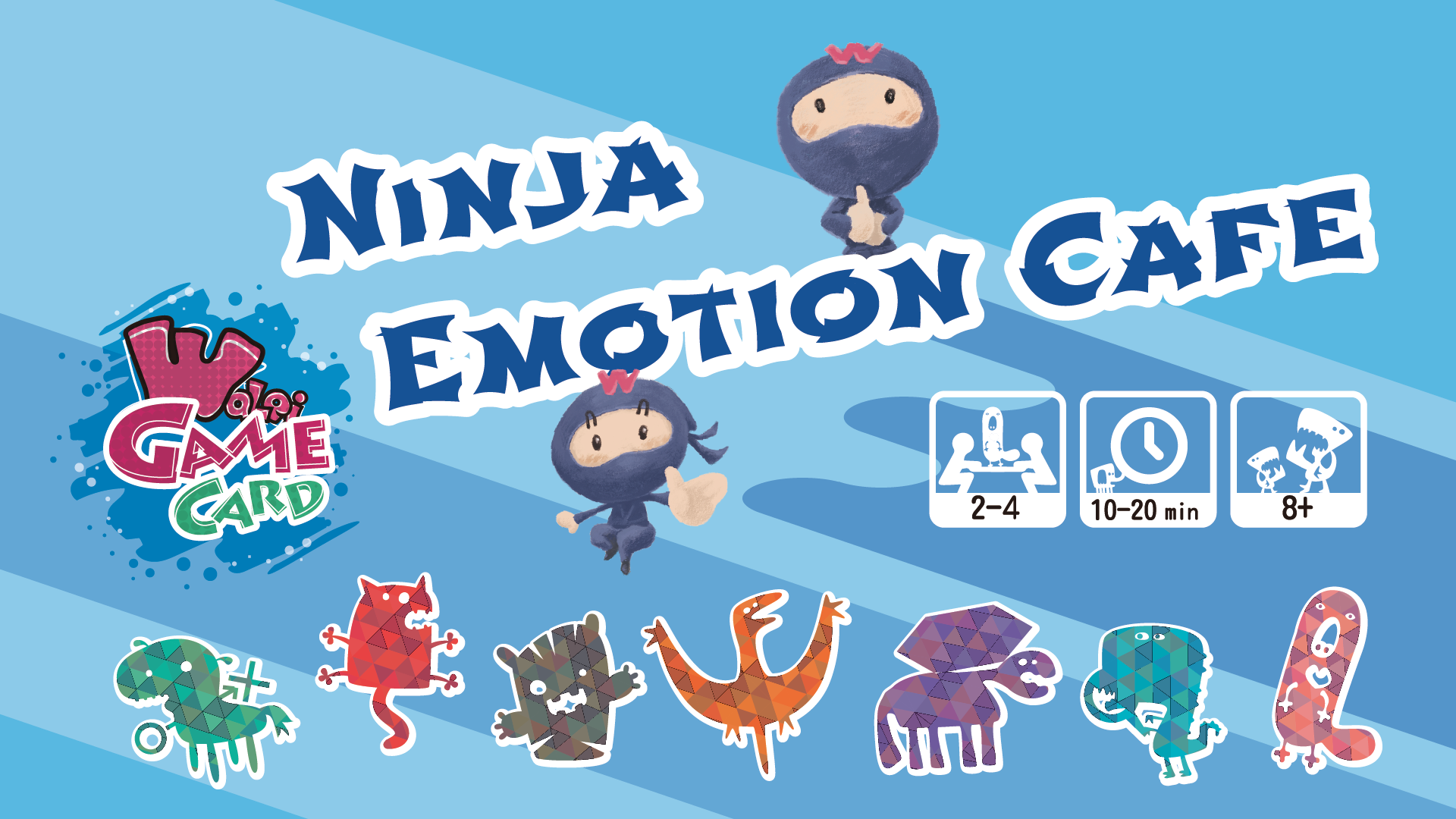
At the end of 2020, we published the Ninja Emotion Cafe curriculum to help students distinguish their emotions, understand the ABC theory of emotions, and recognize the thoughts behind their emotions. Identifying thoughts is the key factor affecting emotions. Through the "Seven Overthinking Monsters," we help students discover "irrational thinking" within their thoughts and find more positive and rational thoughts. By doing so, we can stop negative thoughts from endlessly amplifying negative emotions. We designed the curriculum in an engaging and interactive way, incorporating various media that encourage discussion and reflection, such as videos, quizzes, games, and tabletop activities. This allows children of the Z generation to concentrate and guide their awareness and sharing through Board Games as they grow.
Curriculum Introduction
Lesson 1: Emotion Discerning Meatball
This course guides students through videos to discover that each person has various emotions, which can be classified as "basic emotions" innate to us and "complex emotions" learned through experience. Basic emotions are those that a person naturally possesses and can express without the need for learning. They include happiness, sadness, fear, anger, surprise, and disgust. On the other hand, complex emotions are learned through interactions with others, such as jealousy, shame, embarrassment, and pride.
Emotions convey important messages to us. They not only allow us to survive significant situations quickly through effective and natural responses but also help us build relationships and connections with others. Emotions also inform us about our own needs. When we know what we need, we can take action to meet those needs. Therefore, whether positive or negative, emotions are not categorized as good or bad. Instead, emotions can serve as our map, guiding us on where to go next.
Video: "Emotion Discerning Meatball"
Lesson 2: The Ice-Fire Comfort Sweets
The brain's emotional center, the "amygdala," is responsible for handling negative emotions and is one of the earliest developed parts of the brain. If not properly learned and controlled, impulsive reactions to negative emotions can be relatively quick. On the other hand, the part of the brain responsible for thinking, judgment, planning, impulse control, and problem-solving comes from the "prefrontal cortex." The development of the prefrontal cortex doesn't mature until around the age of 25.
Fluctuations in emotions can affect a person's physiological and psychological state. Failing to address one's emotions properly can lead to physical ailments, difficulties in emotional regulation, and even impact daily life, interpersonal interactions, and task handling. When facing negative emotions, the first step is to leave the uncomfortable environment, as often these negative emotions can subside after about 30 minutes. Next, when emotions are relatively stable, we can try self-talk or talk to someone else to help identify the reasons behind the negative emotions.
Video: "The Ice-Fire Comfort Sweets"
Board Game: Trigger the Landmine
Everyone has situations in life that can easily trigger their negative emotions. In the game, there are 45 different scenarios that can act as triggers. Through a simple card-grabbing game, teenagers not only express their own triggers but also discover that everyone's triggers are different. They learn to respect each other.
Lesson 3: The Emotion Black Box
The process from an event occurring to triggering a brain response takes only 1/5000 of a second. During this time, apart from managing the brain's regular physiological functions, it also rapidly utilizes our past life experiences to make judgments, thereby eliciting emotions. However, this process is exceptionally swift, leading us to mistakenly believe that something external has caused a particular emotion.
According to the Emotional ABC theory proposed by psychologist Ellis, the event (A, Activating event) is merely an indirect cause of triggering emotions and behavioral outcomes (C, Consequence). The true trigger of the outcome (emotion) is the individual's beliefs (B, Belief) about the event.
Video: "A Day with Sadness and Joy"
Board Game: Guess the Emotion
Encouraging teenagers to express their emotions can be challenging. Therefore, six emotion scales and 99 different school, interpersonal, and family events have been designed. Using a six-sided emotion die, everyone guesses each other's emotions. This not only helps practice the Emotional ABC process but also reveals that different people can have different emotions and thoughts about the same event, aiding in the learning of social emotions.
Lesson 4: The Overthinking Baozi
The primary factor influencing our emotions is our thoughts, but sometimes our thoughts are irrational. These irrational beliefs (IB) can lead to even lower emotional states and generate more negative thoughts. Psychologist Ellis believed that many problems are actually "thought up" by people themselves, and often, habitual thought patterns can lead us into emotional distress.
In this lesson, seven of the most commonly encountered irrational beliefs are organized into seven "Overthinking Monsters." This helps students understand and recognize the characteristics of these monsters while also becoming aware of their potential irrational thought patterns.
Video: "The Overthinking Baozi"
Board Game: "Overthinking Monster Series 1: Finding the Overthinking Monsters"
Through a memory card-flipping game, teenagers can memorize the seven Overthinking Monsters.
Each
time
they find three cards of the same monster, they can turn over the "Overthinking Monsters
Illustrated
Card" to learn the monster's name and catchphrase: "Magnification Monsters, Catastrophe Monster,
Mind-Reading Monster, Self-Blame Monster, Extreme Monster, Filtering Monster, Rigid Monster".
The
game
is cooperative, and it can be played in two teams. Finally, with the help of the psychological
test
in
the lesson plan, they can write down the names and catchphrases of the monsters on the
psychological
assessment, discovering which Overthinking Monsters they are most prone to.
Board Game: "Overthinking Monster Series 1: Finding the Overthinking Monsters"
Through a memory card-flipping game, teenagers can memorize the seven Overthinking Monsters. Each time they find three cards of the same monster, they can turn over the "Overthinking Monsters Illustrated Card" to learn the monster's name and catchphrase: "Magnification Monsters, Catastrophe Monster, Mind-Reading Monster, Self-Blame Monster, Extreme Monster, Filtering Monster, Rigid Monster". The game is cooperative, and it can be played in two teams. Finally, with the help of the psychological test in the lesson plan, they can write down the names and catchphrases of the monsters on the psychological assessment, discovering which Overthinking Monsters they are most prone to.
Lesson 5: Battling Overthinking Monsters
After recognizing which Overthinking Monsters they have, students need further assistance in becoming more sensitive to these irrational thoughts. Therefore, Board Games are used to help students become more familiar with the characteristics of each monster. Once they've learned to identify the monsters, the next step is to learn how to adjust their thoughts. This lesson provides weapons and evolution secrets to combat each Overthinking Monster. It also teaches students how to analyze the logic of their thoughts, understand their negative impact, and practice thought transformation.
Board Game: "Overthinking Monster Series 2: Catching the Overthinking Monsters"
This game uses the catchphrase commonly spoken by Overthinking Monsters. In a reverse operation, players guess which Overthinking Monster would say a specific phrase. This helps teenagers become aware of the phrases they often say or think, which might be associated with a particular Overthinking Monster. During the game, each time a catchphrase is revealed, players need to use their newly acquired knowledge of the Overthinking Monster's characteristics to guess which monster it belongs to. If you haven't attended the class, you can familiarize yourself with the catchphrases of the Overthinking Monsters using the "Overthinking Monster Illustrated Card" and then start playing the game.
Board Game: "Overthinking Monster Series 3: Overthinking Monster Evolution"
In this game, players collect seven different weapons to see who can evolve their drawn Overthinking Monsters the fastest. It's a fun and challenging game that adds an element of competitiveness to the learning experience.
Lesson 6: Conflict-Preventing Ice Cream
Main Objective: Transforming Irrational Thoughts into Rational New Thoughts The main goal is to help teenagers transform irrational thoughts into rational ones. Teenage brains are still developing and are quite vulnerable. Prolonged use of "overthinking" logic can exclude other positive and rational thoughts. It's important to actively train them to change their thoughts on their own, rather than simply telling them how to think.
Building on the content from the previous lesson about Overthinking Monster evolution secrets, apply these concepts to their own irrational thoughts or emotional triggers that they commonly experience. The aim is to use the Thought Transformation Chart to assist teenagers in converting irrational thoughts into rational ones. This will help them establish appropriate emotional and behavioral responses within more rational thoughts.
Video: "Conflict-Preventing Ice Cream"
Lesson 7: Heartwarming Comfort Soup
Helping teenagers understand: Even if we bravely express our emotions and thoughts, there is still a possibility of getting hurt. It's important to have the "courage to be rejected" and accept that it's okay even if we are rejected.
Encourage teenagers not to be discouraged. Every mistake is an opportunity to do better next time. As we gain a deeper understanding of the complexities of emotions, through continuous practice and adjustment, we can improve ourselves each time.
Video: "Heartwarming Comfort Soup"
Faith Extension Material
- Lesson 1: Emotion Discerning Meatball - Faith Extension Material
- Lesson 2: The Ice-Fire Comfort Sweets - Faith Extension Material
- Lesson 3: The Emotion Black Box - Faith Extension Material
- Lesson 4: The Overthinking Baozi - Faith Extension Material
- Lesson 5: Battling Overthinking Monsters - Faith Extension Material
- Lesson 6: Conflict-Preventing Ice Cream - Faith Extension Material
- Lesson 7: Heartwarming Comfort Soup - Faith Extension Material
Downloads
- Ninja Emotion Cafe – Board Game InstructionsBoard game rules
- The Interpersonal Detective of the Universe – Board Game InstructionsBoard game rules
- Preview of Lesson 3 Plan – The Emotion Black BoxLesson plan preview
- Lesson 1 – Faith Extension MaterialWeb page
- Lesson 2 – Faith Extension MaterialWeb page
- Lesson 3 – Faith Extension MaterialWeb page
- Lesson 4 – Faith Extension MaterialWeb page
- Lesson 5 – Faith Extension MaterialWeb page
- Lesson 6 – Faith Extension MaterialWeb page
- Lesson 7 – Faith Extension MaterialWeb page
Get the materials
This lesson plan was developed and produced by Walei and is supported by YFC Taiwan. Printed lesson plans and board games are listed under Learning resources (Chinese editions are sold through Walei).
© 2025 哇咧星樂園 walei.tw & Supported by YFC Taiwan.